

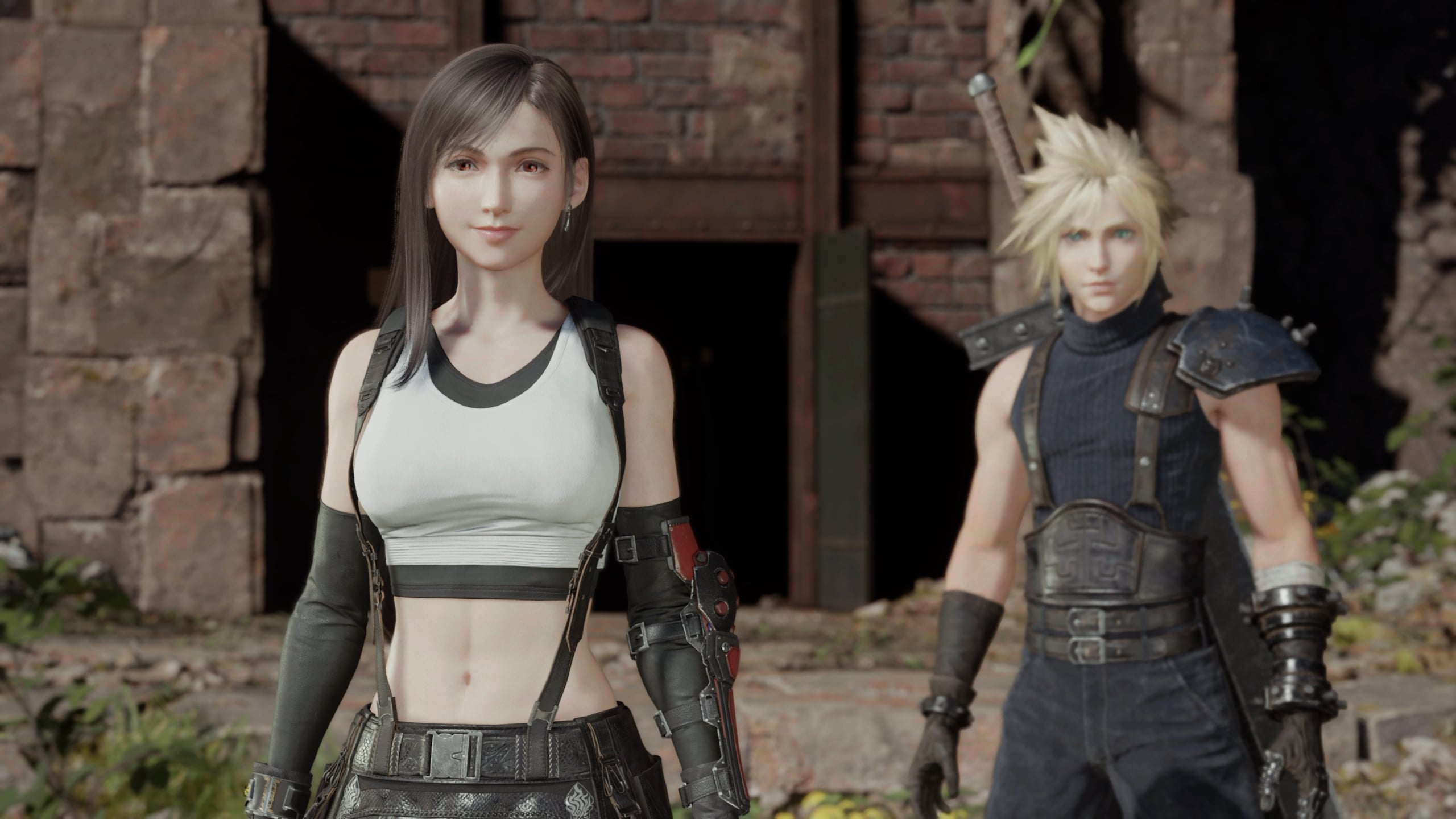

The director of the Last Fantasy 7 Remake trilogy has defined intimately why making the third chapter a multiplatform launch received’t lead to a compromise in high quality.
In an interview with Automaton, director Naoki Hamaguchi was requested his opinion on sure gamers suggesting that the choice to develop Half 3 with Xbox Sequence S and Change 2 in thoughts – slightly than growing primarily for Sony‘s consoles and optimising at a later date – may imply the general recreation could also be compromised to run higher on these methods.
Hamaguchi replied that the choice to go multiplatform with the third recreation “won’t in any approach decrease the standard of the third instalment,” including: “Our growth construction merely doesn’t work that technique to start with… I suppose I’ll simply need to hold saying it.”
When it was put to him that some gamers would think about this advertising and marketing speak and that builders would by no means communicate negatively about their recreation earlier than launch, Hamaguchi mentioned he would “wish to take this chance” to clarify intimately “why there’s no want for concern”.
Hamaguchi went on to clarify the event course of intimately, by way of CPU, GPU, RAM and storage media. Noting that the Change 2 model is a Recreation-Key Card, he defined that there was no must shrink information simply to suit on a slower cartridge.
“As for RAM, the Change 2’s ample reminiscence means there’s little concern there,” he mentioned. “The Xbox Sequence S does have its limits, however we already optimize for every platform individually to absolutely the restrict, so reminiscence constraints on one platform don’t impose restrictions on others.”
When it comes to CPU, Hamaguchi defined that the crew’s philosophy is that if a recreation runs at 30fps on Change 2 or Xbox Sequence S, it ought to be capable of hit 60fps on a higher-end platform. “In different phrases, we don’t design the sport to totally saturate a high-end CPU at 30fps,” he mentioned.
“As an alternative, on {hardware} that lends extra CPU headroom, we scale density components, like growing the variety of NPCs in cities. In consequence, cities really feel extra alive on higher-spec {hardware}, whereas lower-spec methods could show fewer NPCs. So even when factoring in Nintendo Change 2 or Xbox Sequence S help, CPU-related bottlenecks are unlikely.”
Lastly, almost about GPU, Hamaguchi defined: “As our basic precept, we don’t design belongings to satisfy the bottom baseline. As an alternative, we create them for high-end environments first.” The crew subsequently develops with a high-spec PC as its lead platform, and proceeds to scale the sport down accordingly till it hits the bottom specs.
Based on Hamaguchi, PS5 and even PS5 Professional are categorised as “mid-range platforms” by the studio, saying: “In comparison with high-end PCs, texture sizes could differ by roughly 1.5 to 2 occasions, mesh loading by 1.5 to 2 occasions, and polygon counts by greater than 3 times. That’s how huge the distinction will be.
“Conversely, amongst presently supported methods, the one adjusted towards decrease specs is the Steam Deck, because it operates at lower than half the PS5’s baseline. Due to this fact, I’d wish to as soon as once more say that supporting a number of platforms doesn’t affect general high quality.”
Final month Hamaguchi defined that the choice to stay with Unreal Engine 4 for Half 3 slightly than shifting to Unreal Engine 5 was as a result of the event crew has made so many changes to the bottom engine that sticking with it has made for a smoother transition to the third recreation.
“We’ve been utilizing Unreal Engine 4, however we’ve made a whole lot of modifications to suit our wants,” Hamaguchi defined. “It’s extra useful to have one thing we’re already aware of and have custom-made to suit our wants.”
